
Most digital transformation underperforms for the same reason. Organisations optimise the surface – interfaces, platforms, tooling – and leave the underlying substrate those systems ingest and output to users, untouched.
Months (or even years) later, the same constrained performance levels remain. Plans are made to remediate and optimise. And yet the structural constraint was never diagnosed.
The constraint is content.
Why content infrastructure stays invisible
Two inherited biases from the web era explain why content infrastructure stays invisible in transformation planning.
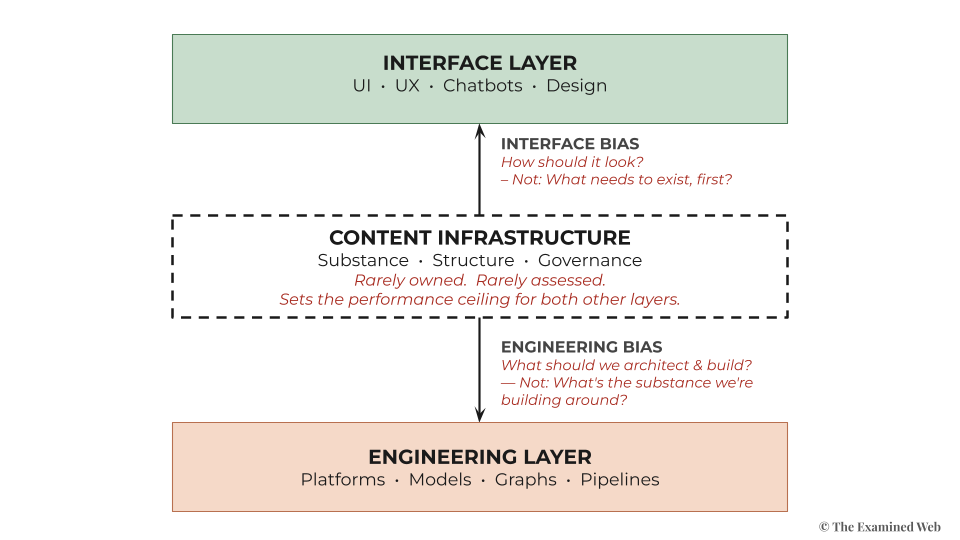
Interface Bias – organisations evaluate digital performance by what’s visible: redesigned homepages, chatbot demos, polished UI. Meanwhile, the operational layer where the majority of durable value lives – retrieval, synthesis, quality assurance, compliance, knowledge management – gets no demo, no vendor pitch, and no board attention.
Engineering Bias – when asked “how to transform,” organisations default to “how do we build?” – custom models, ML teams, proprietary infrastructure, platform migrations, semantic engineering. This focuses attention on technical infrastructure constraints whilst wider content infrastructure constraints remain unassessed.
The compound effect: attention flows to the visible layer, investment flows to the build layer, and the structural constraint remains untouched.
From commodity output to infrastructure foundation
When content is treated as a byproduct of digital products and services, it behaves like one – fragmented, reactive, chaotic.
When content is treated as infrastructure, a different assessment framework emerges. Content-as-infrastructure has three interdependent layers:
Substance
Structure
Governance
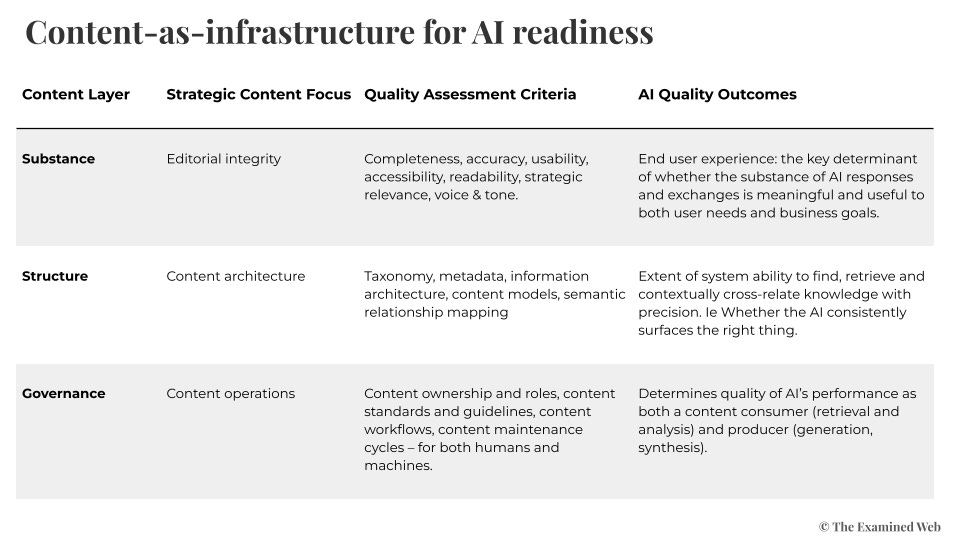
1. Substance
The content quality layer
Is core content accurate, complete, and internally consistent? Can downstream systems – websites, search engines, AI tools – trust what they’re being fed?
Quality gaps here set a hard ceiling. No amount of platform tuning or interface optimisation compensates for contradictory or outdated source material.
2. Structure
The semantic architecture layer
Is there a unified content model across domains? Are taxonomy, metadata, and information architecture aligned – or has each department built its own structural logic?
Structure determines whether information can be found, filtered, synthesised, and reused at scale. Without structural coherence, every digital surface becomes a manual assembly exercise.
3. Governance
The content operations layer
Who owns content across domains? What happens when positioning shifts, products evolve, policies update?
Digital content governance now operates on two surfaces:
Organisational governance – the human ownership models, workflows, and editorial standards that determine how content stays aligned
Platform governance – how tool configurations and encoded features and rules either enforce or undermine that coherence.
Without governance, substance and structure deteriorate. With it, they compound.
What this publication explores
This publication examines digital performance through the lens of content infrastructure.
We’ll start with knowledge AI – mapping the operational applications most organisations overlook, and the infrastructure constraints most AI strategies fail to measure.
From there, we’ll apply the same three-layer model to website and content platform transformation – explaining why redesign cycles plateau, why migrations replicate fragmentation, and what the structural alternatives look like.